Hacking the Bomb: Cyber Threats and Nuclear Weapons by Andrew Futter
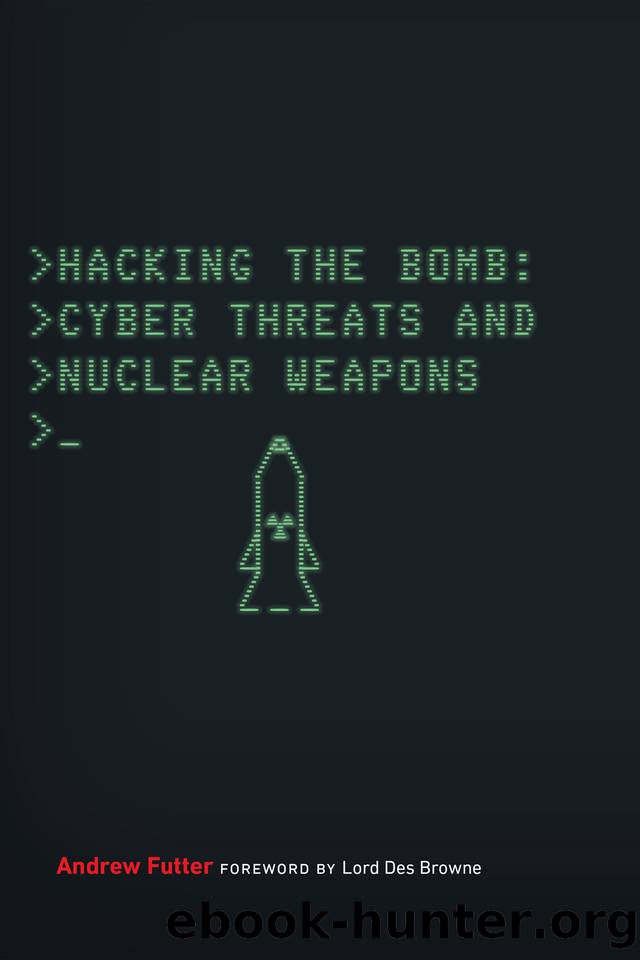
Author:Andrew Futter [Futter, Andrew]
Language: eng
Format: epub
ISBN: 9781626165656
Google: 9HuhtAEACAAJ
Goodreads: 36820220
Publisher: Georgetown University Press
Published: 2018-01-15T09:47:46+00:00
Deterrence by Denial and Deterrence by Punishment
Given the considerable dissimilarities between nuclear and cyber weapons, and the vast range of different operations that fall under the cyber moniker, the response to the cyber challenge will naturally be multifaceted. Any strategy to address these challenges will therefore need to start with (1) a consideration of the possibilities of cyber defense and security, (2) the potential to limit new threats through arms control and other frameworks, and (3) the applicability of deterrence by punishment in the cyber realm. It will also almost certainly involve consideration of how these might be best combined and balanced; just like the threat, the tools required to address the cyber challenge will not be homogeneous.
The management of cyber threats will therefore be split into two components: (1) defense (including possibly active defense) against attackers seeking to steal secrets, interfere with systems, and cause disruption and (2) defense and deterrence against strategic attacks intended to cause damage and destructionâthe focus here. Because the cyber challenge is not uniform, it will require a suite of different types of responses, which will need to be tailored to specific actors and threats. This will necessarily involve both deterrence by denial as well as deterrence through punishment, and perhaps also other tools.37 Part of the problem with the cyberdeterrence debate has been the tendency to conflate the two challenges (and responses), which often results, in the words of a former director of the Los Alamos National Laboratory, Siegfried Hecker, in âstraw man comparisonsâ when considering the possibilities of applying ânuclear-style deterrence in cyberspace.â38 In essence, this is because cyberdeterrence is likely to be far less about punishment than is the case with nuclear deterrence.
The first thing to note is that a significant part of what is labeled âthe cyber challengeâ is best addressed through deterrence by denialâthat is, with better computer network defense, good practices, and enhanced security that deny any benefits (or at least raise the costs) to a would-be attacker.39 As has been explained earlier in this book, the clear majority of cyber operations occur at a relatively low level and involve nuisance, crime, espionage, and exploitationâand they therefore clearly fall well below what one would consider for deterrence through punishment and especially the use of military force.40 Strong defenses, as well as robust cyber hygiene, will create costly barriers for any would-be attacker, and may be particularly useful in deterring terrorists or criminals, who will potentially opt for easier options.41 Deterrence by denial also clearly has a role to play against more serious, strategic cyber challenges, and it is not hindered by the problems of attributionâdiscussed belowâin the same way as is deterrence by punishment.42 As Patrick Morgan notes, this essentially represents a reversal of Cold War nuclear thinking: âFor cyberattacks, the deterrence supplied by defense must now compensate for the limits of deterrence based on retaliation.â43
However, cyber security and defense, and the broader notion of deterrence by denial, are far from panaceasâeven for supposedly air-gapped, highly redundant, and well-protected systems (e.
Download
This site does not store any files on its server. We only index and link to content provided by other sites. Please contact the content providers to delete copyright contents if any and email us, we'll remove relevant links or contents immediately.
| Arms Control | Diplomacy |
| Security | Trades & Tariffs |
| Treaties | African |
| Asian | Australian & Oceanian |
| Canadian | Caribbean & Latin American |
| European | Middle Eastern |
| Russian & Former Soviet Union |
The Secret History by Donna Tartt(19086)
The Social Justice Warrior Handbook by Lisa De Pasquale(12190)
Thirteen Reasons Why by Jay Asher(8909)
This Is How You Lose Her by Junot Diaz(6885)
Weapons of Math Destruction by Cathy O'Neil(6279)
Zero to One by Peter Thiel(5801)
Beartown by Fredrik Backman(5754)
The Myth of the Strong Leader by Archie Brown(5507)
The Fire Next Time by James Baldwin(5442)
How Democracies Die by Steven Levitsky & Daniel Ziblatt(5218)
Promise Me, Dad by Joe Biden(5153)
Stone's Rules by Roger Stone(5087)
A Higher Loyalty: Truth, Lies, and Leadership by James Comey(4960)
100 Deadly Skills by Clint Emerson(4924)
Rise and Kill First by Ronen Bergman(4788)
Secrecy World by Jake Bernstein(4752)
The David Icke Guide to the Global Conspiracy (and how to end it) by David Icke(4717)
The Farm by Tom Rob Smith(4507)
The Doomsday Machine by Daniel Ellsberg(4490)
